
The ‘Joy of Learning’ at Glebe Montessori School
by Savka Wisecup, Montessori Educational Consultant
Why is the ‘joy of learning’ the corner stone of the Montessori curriculum?
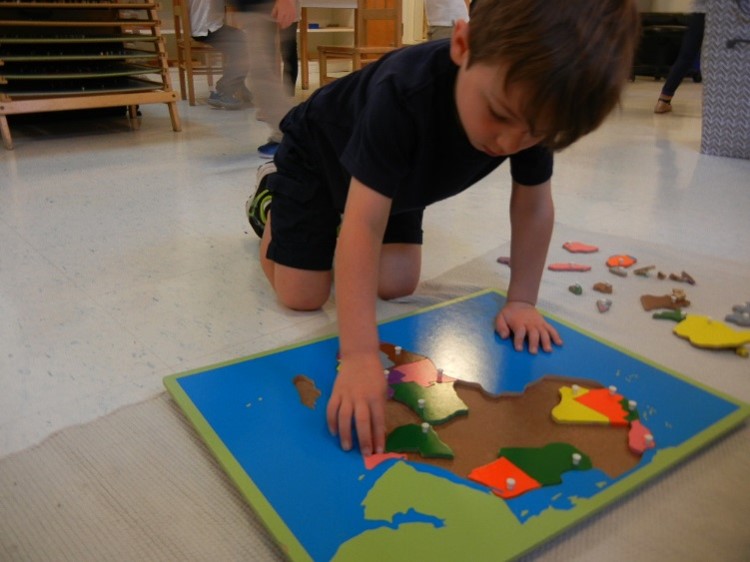 How do students at Glebe Montessori School (GMS) experience the ‘joy of learning’?
The following quote, from Dr. Maria Montessori, reflects GMS’s mission statement regarding the importance of the ‘joy of learning.’ “Joy, feeling one’s own value, being appreciated and loved by others, feeling useful and capable of production are all factors of enormous value for the human soul.”
Key Montessori guidelines for teaching and learning are in place for our students to experience the ‘joy of learning’. These guidelines include smaller classes with a higher teacher to student ratio, trained Montessori teachers who serve as guides to support the unique development of each student, enriched Montessori educational environment with a highly integrated curriculum designed for students to experience ‘hands on’ learning. Each level, from pre-school, to senior elementary (grades 4-6) is a three-year program, where mixed age groups learn from and interact with one another. “There is a great sense of community within the Montessori classroom, where children of differing ages work together in an atmosphere of cooperation rather than competitiveness. There is respect for the environment and for the individuals within it, which comes through experience of freedom within the community.”
The teacher, through observation, connects with the “whole” child, tailoring the curriculum to support the further development and growth of each student, physically, emotionally, socially and intellectually. When students’ individual needs are met, they become motivated from within, pursuing work independently through personal joy and an eagerness to learn. Dr. Montessori so accurately describes this process, stating that “an interesting piece of work, chosen freely by a child, has the virtue of inducing concentration rather than fatigue, adding to the child’s energies and mental capacities, and leading him/her to self -mastery.”
The following examples illustrate this process. The Montessori teacher gathers a few three-year-old students for a group lesson, to introduce the continent puzzle map. The students learn the names of the continents, handle the puzzle pieces and have a short discussion about continents. When a student wants to know more, s/he independently selects an envelope with animal pictures of a continent for further discovery. When the lesson is presented to a group of four-year-old students, more details are presented. For those who want to continue with the lesson, activities such as creating a continent booklet is made available. Each continent puzzle piece is traced, coloured and labeled to complete this continent booklet. For a five year old who already knows the names of the continents, has viewed the relating picture envelopes and has made a continent booklet, and wants to do and know more, there are advanced activities. Children can engage in interactive Montessori materials to explore the names of countries in a specific continent, flag identification and cultural topics such as traditional foods, languages spoken and local customs. Children are invited to embark on personal journeys of self-discovery and learning to further awaken their imagination and curiosity. This is the true joy of learning!
For our elementary students, Dr. Montessori introduced The Great Lessons to spur their imagination and encourage follow-up research and exploration. “Clearly, these five stories encompass an enormous amount of information about the origins of the world around us. When each story is shared, it should never be left alone – there should always be further study open to the children so that the story becomes the springboard, not the focus. The stories can be referred to throughout the year when new topics are introduced, as a way of providing unity and cohesion to such a wide variety of studies.” (montessoriforeveryone.com)
The First Great Lesson, the Coming of the Universe and the Earth, is introduced on the first day of school with an exciting presentation demonstrating how the beginning of the universe was created with the Big Bang. The Second Great Lesson is the Coming of Life, which illustrates how microorganisms, plants and animals started to inhabit the earth. The Third Great Lesson introduces the Coming of Human Beings, followed by the Fourth Great Lesson, The Story of Communication. The Fifth Great Lesson tells The Story of Numbers. In addition to the comprehensive, integrated elementary curriculum, these Montessori Great Lessons hold enormous possibilities for our elementary students to further research, explore, discover and expand their knowledge of our world, as well as their imagination.
Dr. Montessori believed learning should be a natural and joyful experience for all children and that it is our responsibility, as educators, to provide an educational framework that facilitates the love of learning. “The child who has felt a strong love for his/her surroundings and for all living creatures, who has discovered joy and enthusiasm in work, gives us reason to hope that humanity can develop in a new direction.” (Dr. Maria Montessori)